
Complex 3D Analysis
Complex scaffolds don’t fail because a single ledger is a bit stressed — they fail when the whole structure behaves differently to what everyone assumed. That’s why, for higher-risk or non-standard scaffolds, we carry out full 3D structural analysis in SCIA Engineer to prove global stability, load paths and tie demands under realistic loading and wind conditions.
By modelling the scaffold in 3D, we can quantify how forces distribute through standards, ledgers, transoms and ties, identify the governing elements, and demonstrate performance for designs involving sheeting, bridges, cantilevers, façade retention interfaces, restricted tie locations, or unusual geometry. The result is a calculation package that’s not “computer says yes” — it’s clear, engineering-led justification that stands up to temporary works review and independent checking.
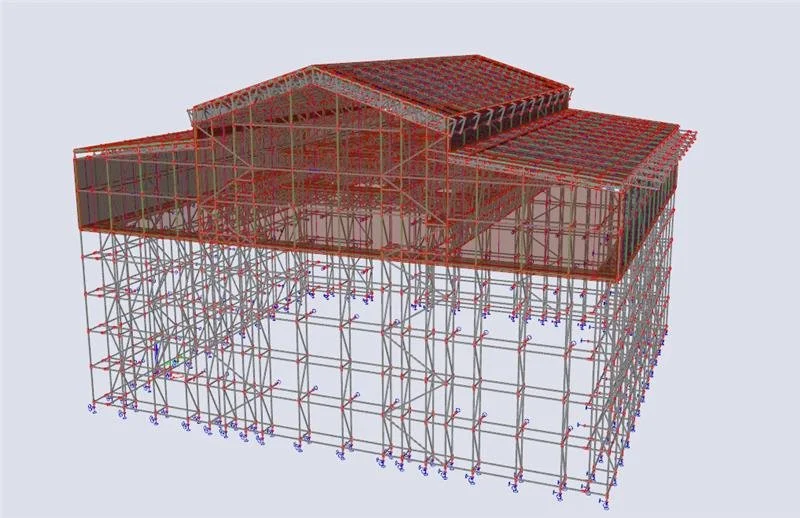
Frame Model
This 3D frame model represents the true scaffold geometry — standards, ledgers, transoms and key restraints — built to reflect how the structure will behave once erected. By modelling the layout accurately from the outset, we can verify load paths, stiffness and global stability rather than relying on isolated member checks.
It also allows us to pick up early issues such as slender bays, long unbraced lifts, eccentric returns, irregular plan shapes or restricted tie positions, before they become site problems. In short: this is the “digital twin” of the scaffold, and it forms the foundation for every load case and result that follows.
Wind Panels
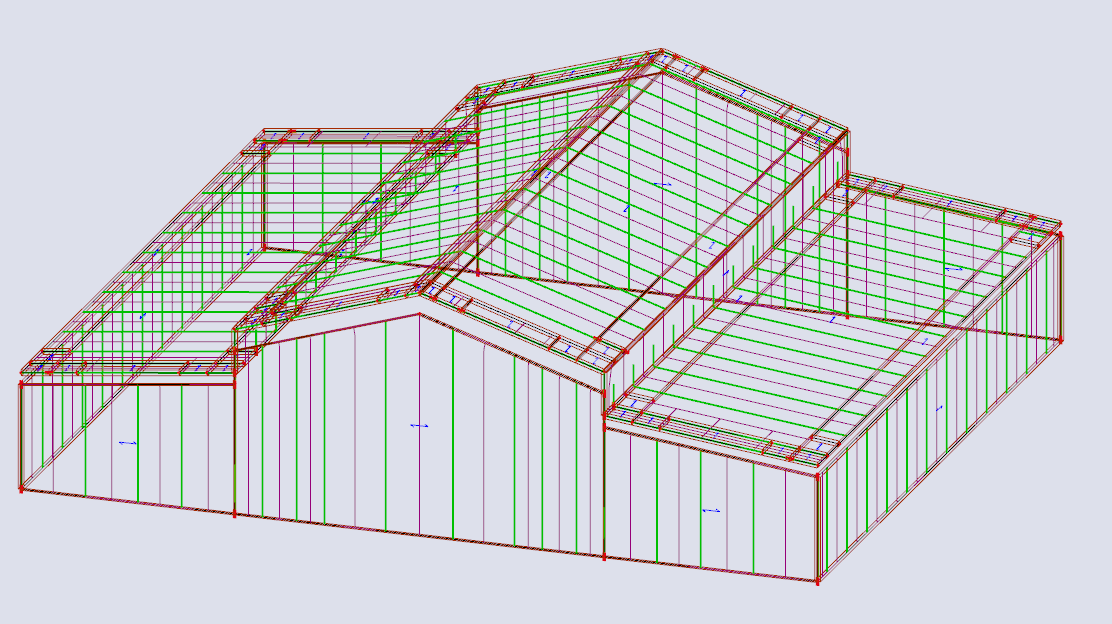
This view shows the wind panels applied to the scaffold envelope. In SCIA, we represent the sheeting/netting and any temporary roof faces as loaded surfaces, so wind actions are applied where they actually hit — across elevations, returns and roof slopes — rather than being guessed as a single “lump load”.
By modelling the panels this way, we can test multiple wind directions, capture edge and corner effects, and quantify the resulting horizontal forces, overturning moments and uplift. That gives us a defensible output for tie loads, brace demands and base reactions — which is exactly what you need on sheeted scaffolds where wind is usually the governing design case.
360 Structural View
This short video gives a 360° view of the full SCIA model, making it easy to understand the scaffold’s geometry, bracing lines, tie locations and wind panel coverage in one go. It’s a simple way to visually confirm that what’s been analysed matches what will be erected on site — particularly on complex layouts with multiple roof slopes, returns and elevation changes.
By rotating around the model, we can also highlight the key stability features and explain why certain ties, braces or restrictions are required, helping the design move smoothly through temporary works review and approval.
Global Behaviour
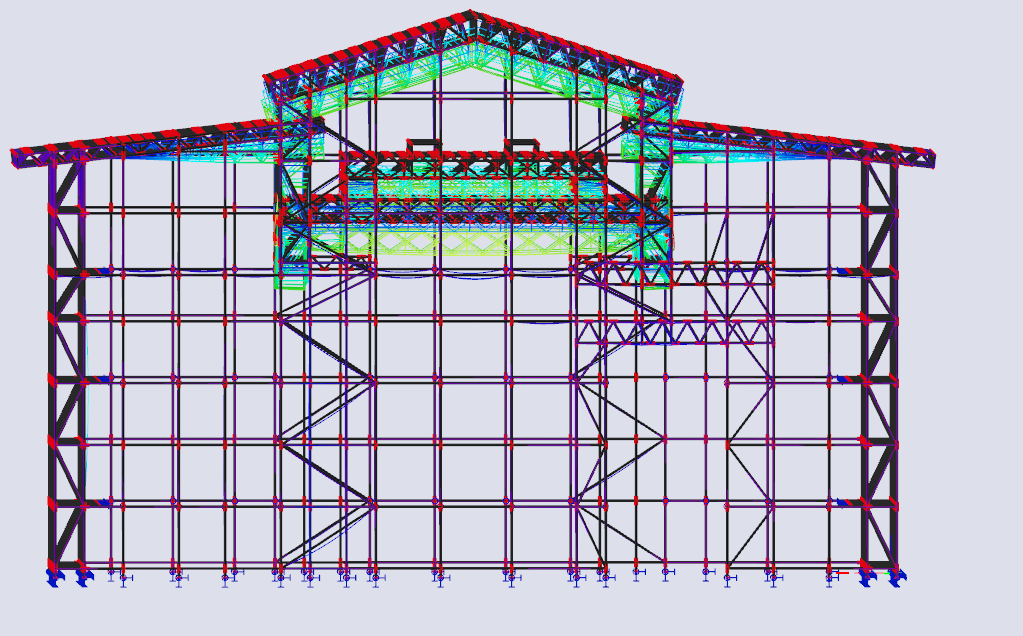
This results view highlights how the scaffold actually behaves under the governing load cases. The contour map and deformed shape (often shown with exaggerated movement for clarity) allow us to check sway, overall stiffness and load distribution across the structure — not just whether individual members are adequate.
It’s particularly useful for identifying what controls the design on complex or sheeted scaffolds: areas of higher utilisation, increased tie demand, local flexibility, and any zones where additional bracing or restraints are required. In short, it turns the analysis into clear, visual evidence that the scaffold remains stable and serviceable under real-world loading.
Need a complex scaffold design? Get in touch today by email or phone to discuss your project and required submission information.